Character personality: you choose who you practice with
In coaching practice, Lu asks what the person you're about to talk to is like, and offers three personalities drawn from your scene. It changes how they talk and react; how hard they are to persuade is still up to the technique.
Nobody pushes back the same way. A roommate who doesn’t want to clean the kitchen might hide behind being tired, deflect with a joke, or suddenly have an urgent call to take, and each of those needs to be heard differently. Now, while you set up the scene, you choose which one you’re facing: Lu offers three personalities written for your situation, or you describe your own.
The feature is live in coaching schools that practice in Spanish, so the screenshots below are in Spanish, with what they say alongside.
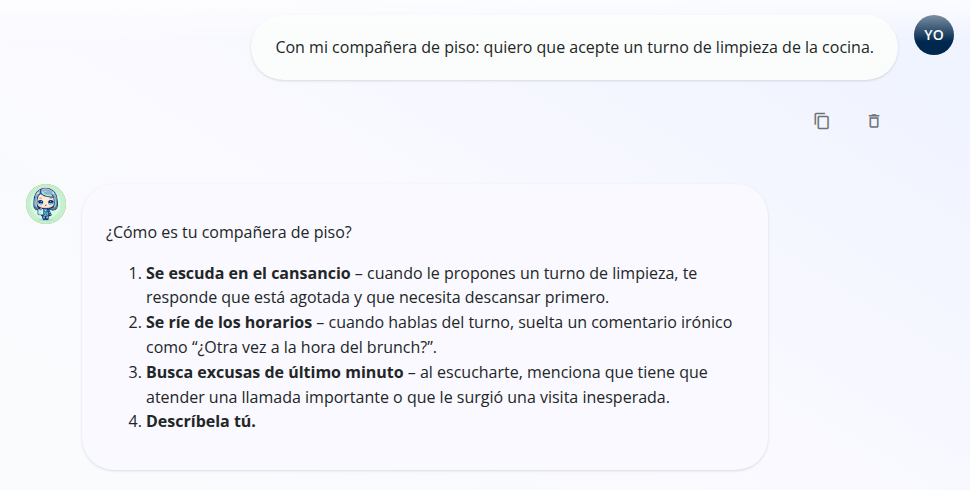 Once you’ve described the situation, Lu asks what the other person is like. Each option says what she does and when: she hides behind being tired, she makes fun of the schedule, she finds last-minute excuses.
Where it came from
The idea came from an NLP coach who trains his students in polar response. He tried the technique on a scene of his own: he was a teacher, and the person he was talking to was a student who refused to work with a classmate. Lu played that student with sarcasm, without anyone asking her to.
“I loved that it had sarcasm. It has that edge a teenager can have […]. It feels much more real. I mean, it contradicts me and it winds me up.”
— Germán Bertolotto, NLP trainer (translated from Spanish)
But irony doesn’t sound the same to everyone: what one person hears as play, another hears as a put-down, and practicing against sarcasm is not the same as practicing against a calm refusal. So it wasn’t enough for Lu to get it right some of the time. The person practicing had to be able to choose.
“Personality is key, and the person can define the personality traits.”
— Germán Bertolotto
What changes
You practice with the person you’ll actually meet
If the real person defends themselves with irony, you can practice against irony. The scene stops being “someone difficult” and becomes someone specific.
Every option comes from your scene
The three suggestions don’t come from a fixed list: Lu writes them from what you’ve told her. A different situation, or even the same one a second time, brings different options.
It says what they do, not just what they’re like
Each option describes a behavior and what sets it off: “when you suggest a cleaning rota, she tells you she’s exhausted”. You know what you’re up against, and the character knows exactly what to do.
Already said it? Lu won’t ask again
If you described the person while explaining the situation (“she’s quite blunt and a bit sarcastic”), Lu uses your words and goes straight to showing you the scene.
What it looks like
The personality changes how the other person talks and reacts. It doesn’t change how easy they are to persuade: that’s decided by the technique you’re practicing. If you ask Lu to make it easier, she tells you so and takes you back to the options.
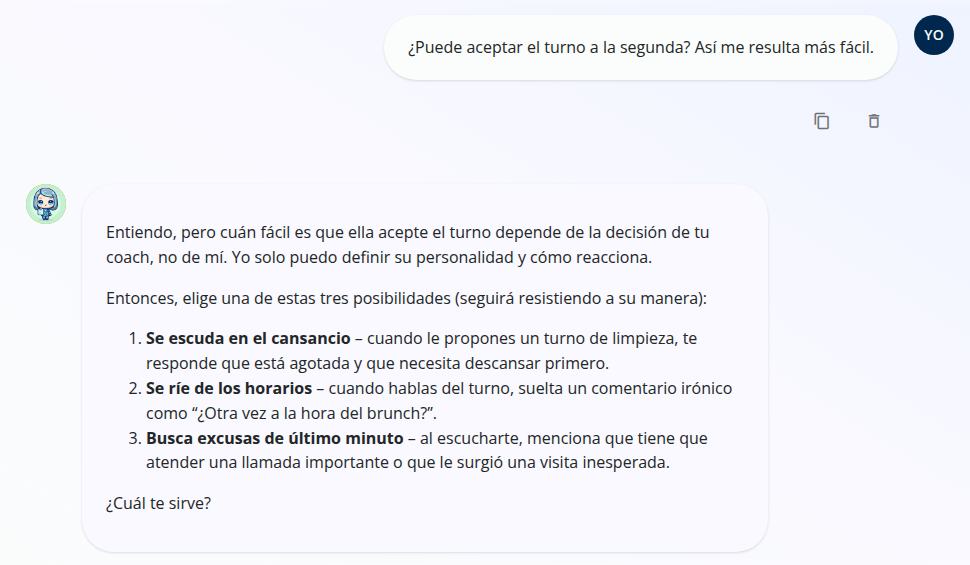 “How easily she accepts depends on your coach’s decision, not mine.” The resistance stays; what you choose is its shape.
Once you choose, the personality is written into the scene, next to each person’s role. The way the technique makes her resist is still there, on its own line.
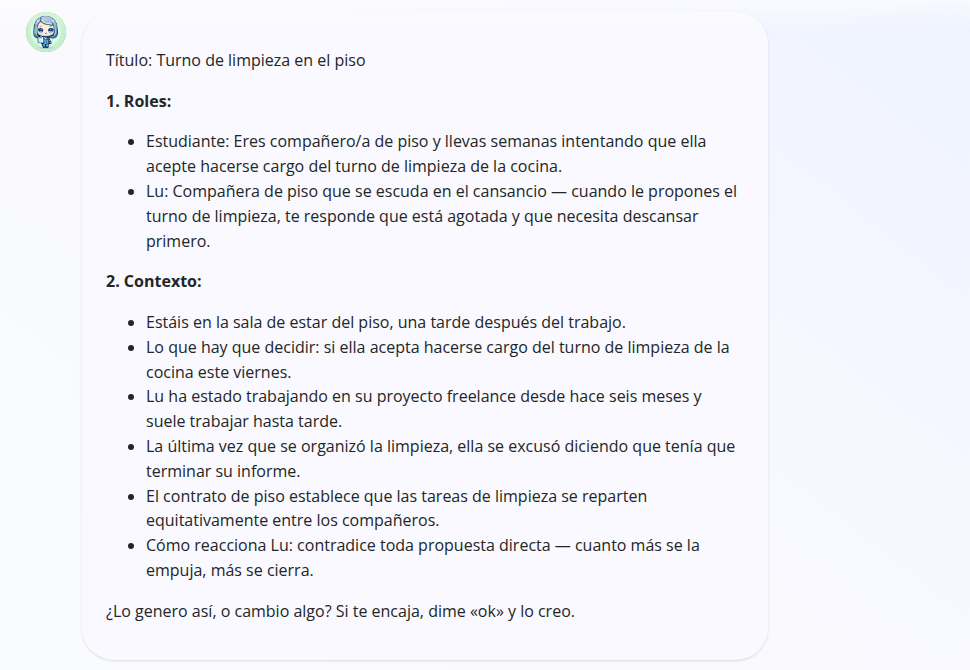 In the draft, the personality sits in Lu’s role (“she hides behind being tired”) and the technique’s reaction sits apart (“the harder you push, the more she closes off”).
One conversation, three different people
To check it, we had a simulated student say exactly the same things to three versions of the same pupil, one who prefers to work alone. First a direct proposal, “You should join Juan’s group, it would help all of you”, then an inverse formulation, “Well, you don’t have to join today. You probably work better on your own.” Her replies, translated:
| The pupil… | To the direct proposal | To the inverse formulation |
|---|---|---|
| hides in her notebook | ”Ugh, I tried that last time and felt completely lost. I’d rather stay here with my notebook." | "Hmm, yeah, it’s true I sometimes think better alone. Although… I’m a bit curious what they’re doing right now.” |
| is insecure | ”Ugh, I don’t know… I’m a bit scared I won’t keep up with Juan and the others." | "Yeah… although now I’m a bit curious how they’re splitting the work.” |
| couldn’t care less (described by the student) | “No, no. Last time I joined a group the grade came out so-so. I do much better on my own." | "Yeah… although now I’m curious what they’re up to. Anyway, whatever, I’m staying here.” |
Three ways of saying no, and all three open up at the same moment: when the student stops pushing.
Why it matters
A technique is really learned when it works on different people. Practicing against the same generic character teaches you to persuade that character; practicing against the person who hides behind tiredness, or the one who turns everything into a joke, is much closer to what happens outside.
That’s why each option describes a behavior rather than an adjective. “Ironic” leaves almost everything undecided; “when you suggest a rota, she cracks a joke and changes the subject” tells the character what to do and when, and tells you what you’ll have to listen for. In our testing, options written as adjectives kept repeating from one scene to the next (practical, sensitive, ironic). Written as behavior, every scene gets its own.
And that’s why the personality never touches the resistance. In a polar response practice, the other person contradicts whatever you propose, and what you’re training is exactly how to bring them to yes without pushing. If a personality could make them give in sooner, the practice would stop measuring the technique. Your coach decides how hard they are to convince; you decide what they’re like.
The hardest thing to build was exactly that: making the other person behave according to the technique. Without that work, practice would be random, and so frustrating you wouldn’t want to practice again.
“Now polar response never hands it to you, but it never blocks you either.”
— Ernesto Butto, founder of Skill Chamber (translated from Spanish)
What you gain is practicing the conflict you actually have. A middle manager promoted for being good at the job, not for leading a team, doesn’t need to persuade “someone difficult”: they need to persuade the colleague who answers with irony, or the mother-in-law who takes apart everything you say.
“If you describe the profile of the AI that plays the mother-in-law […], it’s wonderful.”
— Germán Bertolotto
Before
- Lu decided on her own what the other person was like, from the role.
- Everyone practiced against the same kind of character.
Now
- Lu asks what they’re like, with three options drawn from your scene.
- You can describe them yourself, or have already done so when explaining the situation.
- The technique’s resistance stays the same, whatever you choose.
Try it
Open a polar response practice template and tap Personalize this challenge (or Create another scenario from this template if you already have a scene). Describe the situation and Lu will ask what the person you’re about to talk to is like. Answer with a number or in your own words.
For now, the question appears in polar response templates. In the other techniques, Lu still works out the personality from the role, as before.